

2026-11-05
When planning an industrial lighting upgrade for a large-scale warehouse, distribution center, or logistics hub, specifying the right control protocol is just as critical as choosing the luminaire wattage or CCT. Facility managers and electrical contractors frequently face a foundational architecture question: Should I specify a DALI (Digital Addressable Lighting Interface) or a 0-10V dimming system for my warehouse?
Choosing the incorrect dimming protocol can lead to runaway installation labor costs, complex wiring mistakes, limited automation flexibility, or premature system incompatibility. While 0-10V has long been the North American and commercial baseline due to its simplicity, DALI has emerged as the global standard for smart, addressable, two-way industrial automation.
For a standard warehouse, 0-10V dimming is best suited for cost-sensitive, zone-based lighting where simple analog dimming and basic occupancy or daylight harvesting are required across large open bays. DALI (Digital Addressable Lighting Interface)—specifically DALI-2 and D4i—is the superior choice for modern smart warehouses requiring granular fixture-level monitoring, individualized addressability, automated fault reporting, multi-zone re-grouping without rewiring, and seamless integration with IoT sensor mesh networks.
| Technical Parameter | 0-10V Analogue Dimming | DALI / DALI-2 / D4i Digital Protocol |
| Signal Type | Analog DC voltage signal (0V to 10V) | Digital bidirectional serial communication data protocol |
| Wiring Topology | Daisy chain with dedicated low-voltage control pairs | Free topology (bus, star, tree) with polarity-free 2-core wire |
| Addressing Capability | Zone/Group control only (all fixtures on a wire dim together) | Individual device addressability (up to 64 drivers per loop) |
| Two-Way Communication | None (Unidirectional; controller sends, light obeys) | Full bidirectional feedback (power draw, fault status, operating hours) |
| Re-zoning Flexibility | Requires physical rewiring or relay adjustments | Software-based re-zoning (no physical rewiring needed) |
| Max Control Distance | Voltage drop over long wire runs causes dimming drift | Up to 300 meters without signal degradation |
| Initial Capital Cost | Low to Moderate (cost-effective for basic spaces) | Higher (requires DALI gateways and commissioning) |
The 0-10V protocol is a direct current (DC) analog lighting control method. The driver receives a control voltage between 0V (minimum output, typically 10% brightness) and 10V (maximum 100% output).
Wiring Reality: Because it is analog, every fixture connected to the same control wires dims to the exact same level simultaneously. To create separate lighting zones (e.g., aisle 1 vs. aisle 2), separate low-voltage control wire pairs must be pulled back to the panel.
Voltage Drop Vulnerability: In massive warehouses with long cable runs (exceeding 100–150 meters), wire resistance can cause voltage drop, resulting in fixtures at the end of the line glowing brighter than those near the controller.
DALI is an open international standard (IEC 62386) operating via a digital two-wire bus. Instead of sending raw voltage, the controller sends digital data packets containing specific commands and addresses.
Independent Addressing: Each DALI driver on a loop is assigned a unique digital address. Even if 50 high-bay lights share the same physical power and control wires, a programmer can command High Bay #12 to dim to 30% while High Bay #13 remains at 100%.
Fault Feedback: DALI offers bidirectional communication. If an LED driver overheats or a diode fails, the system logs the exact device ID and error code, minimizing troubleshooting time in 12-meter-high facilities.
Modern e-commerce fulfillment centers operate 24/7 with automated guided vehicles (AGVs), dynamic picking aisles, and strict energy-saving mandates.
Why DALI Wins: DALI allows integration with microwave occupancy sensors and daylight harvesting. If Aisles 10 through 15 are empty, DALI dims those specific high bays down to 10% while keeping active packing zones at 100%. If racking layouts change next month, facility engineers can re-zone the lighting via software without pulling a single new control wire.
For standard dry warehouses or bulk material storage facilities where all lights along a wide open aisle are turned on and off together, complex digital addressability is often unnecessary.
Why 0-10V Wins: 0-10V drivers are universally supported by almost all industrial LED high bays, cost less upfront, and require zero software commissioning. When paired with basic motion sensors, 0-10V delivers reliable, hassle-free energy savings on a tight budget.
When specifying industrial luminaires—such as Unicornlite's high-efficiency LED high bay lines or heavy-duty fixtures—ensuring driver compatibility with your chosen control protocol is vital:
Driver Partnership: High-grade industrial fixtures utilize robust constant-current drivers (such as Sosen or Inventronics) that support 0-10V dimming as a default while offering optional DALI-2/D4i upgrade sockets.
Sensor Ready Sockets: Many advanced high bays now feature 7-pin NEMA or Zhaga receptacles, allowing plug-and-play installation of microwave motion sensors or wireless lighting control nodes (such as Casambi or Bluetooth mesh) alongside wired DALI buses.
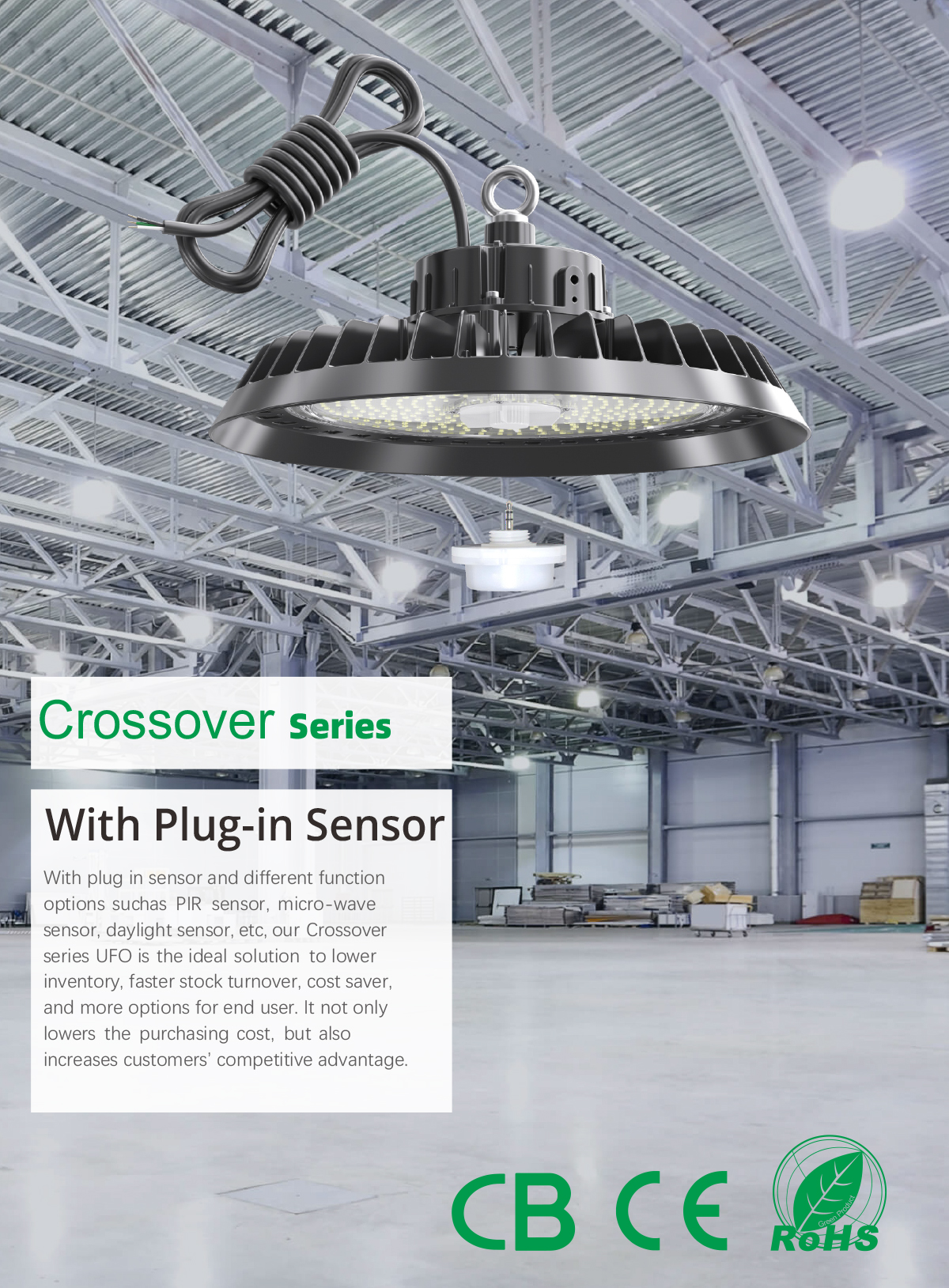
While choosing between DALI and 0-10V provides the underlying signal architecture, the physical luminaire choice dictates overall project ROI. For modern warehouses seeking maximum energy savings without complex digital commissioning, Unicornlite offers the Crossover Series UFO High Bay.
Crossover Series Core Advantages:
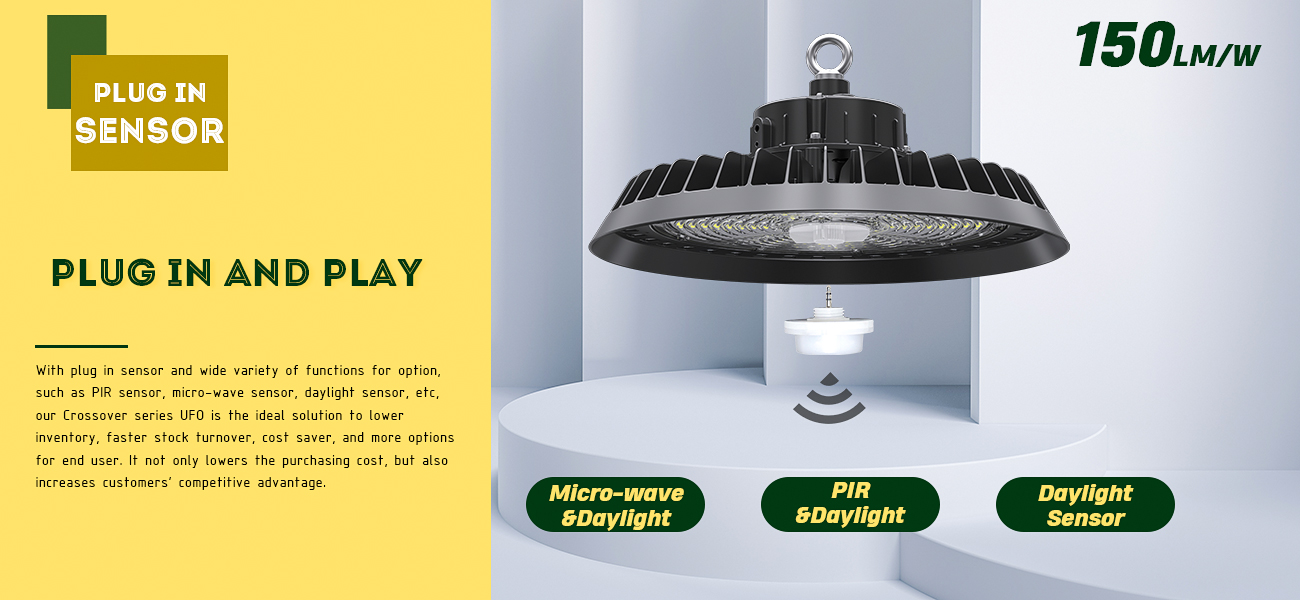
Plug-in Sensor: PIR / Microwave / Daylight Sensors
High Efficacy: 150 lm/W
Sosen Driver & Philips LEDs
Plug-and-Play Sensor Flexibility: Equipped with an innovative plug-in port supporting interchangeable PIR sensors, microwave sensors, and daylight sensors. Facility managers can add or swap sensors instantly without complex rewiring.
Extreme Energy Efficiency: Delivers 150 lm/W using premium Philips LEDs and reliable Sosen drivers, cutting monthly energy consumption by 40% to 60% when paired with daylight harvesting and motion dimming.
Lower Inventory & Purchasing Costs: Standardized modular options lower SKUs for distributors and reduce initial capital outlay for contractors while maximizing end-user flexibility.
Robust Industrial Build: Features IP65 waterproof rating, IK08 impact resistance, 4KV surge protection, and a 5-year warranty, ensuring long-term reliability in demanding warehouse environments.
A: Physically, yes, provided the fixture drivers support DALI or can be swapped out. However, 0-10V uses simple analog wiring pairs while DALI requires a digital bus control line. Full conversion usually requires replacing the low-voltage control wiring topology and installing a DALI controller gateway.
A: Yes, initial capital expenditure for DALI is generally higher due to the cost of addressable drivers, DALI system controllers, and software commissioning labor. However, DALI often yields lower long-term operational costs in large facilities through precise energy management and automated fault reporting.
A: Yes, both systems can integrate with emergency battery backup packs. DALI-2 systems offer an advanced advantage by supporting automated self-testing protocols (scheduled monthly and annual battery discharge tests), reducing manual maintenance labor in high-ceiling warehouses.
Whether your facility requires cost-effective 0-10V zoning or advanced DALI-2 smart building automation, partnering with an experienced manufacturer ensures seamless integration. Contact Unicornlite to discuss your project parameters, request photometric layouts, or source high-performance industrial LED fixtures tailored to your control specifications.


